Last Updated on August 23, 2026
Estimated reading time: 7 minutes
Author: Jessa May Bautista
Reviewed by: Josh Blanchard
Fact Checked by: Jack Aldous
Florida has its own rules for tax lien and tax deed investing. We recorded this guide to help newcomers understand how auctions work, how interest is calculated, and where to find over‑the‑counter opportunities. Below we answer the most common questions in simple language and share links to county resources and related articles.
Table of contents
- What Is a Tax Deed?
- What makes Florida different from other states?
- How do Florida tax lien auctions work?
- How is interest on a tax lien calculated?
- What happens if the taxes remain unpaid?
- Where can I buy over‑the‑counter liens and deeds?
- What are the key rules for Florida tax lien investing?
- Ready to take the next step?
What Is a Tax Deed?A tax deed is a county legal document that gives the county title to a property when real estate taxes stay unpaid long enough. After that, the county sells the property to recover the unpaid taxes.
What makes Florida different from other states?
Florida stands out because it sells tax lien certificates and tax deeds in one system. You can earn interest when owners redeem, or move to a tax deed and an auction if they do not.
Florida sells both tax liens and tax deeds. A tax lien certificate is a claim on property for unpaid taxes; you pay the taxes and earn interest until the owner redeems. If the taxes are not paid, you can eventually apply for a tax deed and the property is sold at auction. Florida’s maximum statutory interest rate is 18 % simple interest, and unsold certificates struck to the county also earn 18 %. This dual structure allows investors to earn interest or acquire property, depending on the outcome.
Key Takeaways
- Florida offers both tax lien certificates and tax deeds, allowing investors to earn interest or acquire property.
- Tax lien auctions are reverse auctions where the interest rate is bid down from 18%, and certificates can be purchased over the counter if unsold.
- Interest on tax liens is simple and accrues monthly, with a guaranteed minimum return of 5% if redeemed quickly.
- If taxes remain unpaid for two years, the certificate holder can apply for a tax deed through a public auction.
- Research is crucial before bidding, as properties are sold ‘as is’ and may include hidden costs or issues.
How do Florida tax lien auctions work?
Certificate sales are typically held in late May or June. You may need to pre‑register a month ahead. Counties run reverse auctions where the interest rate is bid down from 18 % in 0.25 % steps. The bidder willing to accept the lowest rate wins the certificate. Bids of zero percent are allowed but offer no return. Counties like Sarasota, Broward and Hillsborough host their auctions online through vendors such as Grant Street or RealAuction. If a certificate receives no bids, it is “struck” to the county and later sold over the counter at 18 % interest
How is interest on a tax lien calculated?
Interest is calculated each month using one twelfth of the yearly rate. That monthly amount is added as the lien stays in place, based on the rate shown on the tax certificate. The law can also set a minimum return if the certificate is redeemed fast.
A certificate won at 18 % earns 1.5 % per month. Florida law guarantees a minimum return of 5 % if the certificate is redeemed quickly. The table below shows how monthly interest compares with the guaranteed penalty.
| Months held | 18 % interest (simple) | Minimum return (penalty) |
| 1 month | 1.5 % | 5 % |
| 2 months | 3 % | 5 % |
| 3 months | 4.5 % | 5 % |
If a homeowner redeems after three months, the investor would receive 5 % instead of 4.5 %. Simple interest is calculated on the original amount only and does not compound
What happens if the taxes remain unpaid?
If a certificate is not redeemed within two years from April 1 (the date taxes become delinquent), the certificate holder may apply for a tax deed The applicant must pay all outstanding taxes and fees, including other certificates, and a title search fee. The clerk then schedules a public auction. For homestead properties, half of the assessed value is added to the opening bid. Interest continues to accrue on the costs advanced until the sale. If someone else buys the property, the certificate holder is reimbursed for all costs plus 1.5 % per month until the sale
Life span and risks
Florida certificates expire after seven years if no tax deed application is filed, and the certificate is void at that point. After expiration, the certificate is void and your investment is lost. You may not contact the property owner to demand payment; doing so can bar you from future sales. Counties also caution that tax deed sales convey property “as is” and do not guarantee clear title. Always research liens, zoning, environmental issues and homestead status before bidding.
Where can I buy over‑the‑counter liens and deeds?
Many counties publish lists of unsold certificates or deeds:
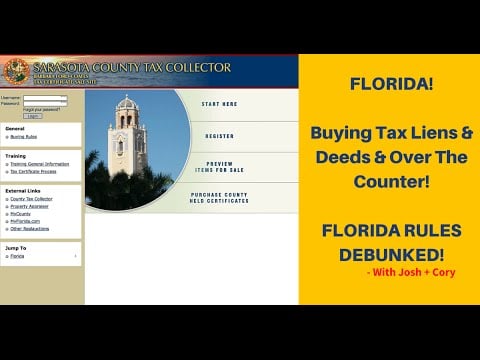
- Sarasota County. The tax collector’s site allows public purchase of unsold certificates at 18 % interest You must register and fund your account before buying. County‑held certificates may date back several years, so check redemption history.
- Broward County. Auctions and over‑the‑counter purchases are handled through RealAuction. You can view available certificates and deeds once registered.
- Hillsborough County. The county lists over‑the‑counter tax deeds and certificates through Grant Street’s LienExpress portal. Tax deed auctions are held on Thursdays at 10:00 a.m.; verify the schedule with the clerk.
- Other counties. Many Florida counties use similar platforms. Look for “tax certificate sale” or “tax deed sale” on the county tax collector’s website to find registration links and unsold lists.
What are the key rules for Florida tax lien investing?
Florida tax lien investing works by buying a certificate, waiting out the redemption period, and then acting on a deed. You also need to plan for deposits and other purchase costs, watch homestead rules, and check property condition and other liens before you bid
- Understand redemption periods. Property owners may redeem the lien at any time before a tax deed is issued.
- Budget for costs. Bidding on deeds requires deposits (often $200 or 5 %) and immediate payment if you win.
- Check homestead status. Homestead property adds half of the assessed value to the opening bid, which can make the property expensive to acquire. Redemption periods are longer for homestead properties (24 months).
- Watch the clock. Apply for a deed promptly after two years; otherwise the certificate may expire after seven years
- Do your research. As Brevard County warns, properties are sold “as is” without warranties. Inspect in person or hire professionals to check for other liens, code violations or environmental issues. Our article on tax deed property selection explains how to build a list and evaluate properties, including budget tips and a case study.
- Stay patient and organised. Successful investors track redemption dates, maintain records and reinvest returns. Consistency is the number‑one trait for success, as discussed in our guide on building patience and perseverance.
FAQs
They’re reverse auctions. Bidding starts at 18% interest and goes down in 0.25% steps. The lowest acceptable rate wins. Unsold liens go to the county and can be bought later over the counter at 18%.
Interest is simple, not compounded. It accrues monthly at 1/12 of the annual rate (e.g., 18% = 1.5% per month). Florida law guarantees at least a 5% return, even if redeemed quickly.
After two years from April 1, the lien holder can apply for a tax deed. The county schedules a deed auction, and the lien holder is reimbursed if someone else buys.
Certificates expire after 7 years if no tax deed application is filed. After that, they’re worthless.
Counties like Sarasota, Broward, and Hillsborough publish unsold lists on portals such as RealAuction, Grant Street, or LienExpress.
Ready to take the next step?
Yes, you can take the next step. Start with clear steps and free resources that help you avoid common mistakes. Learn how tax lien and deed buying works, then use the mini course and auction calendar to plan what to do next. If you want help, schedule a free call.
We’ve been investing in tax liens and deeds for many years and can help you avoid common mistakes. If you’re ready to buy your first tax deed property up to 90 % off or want to earn steady returns with tax liens, check out our free resources. Our mini course shows you how to buy tax lien and deed property for pennies on the dollar, and our auction calendar lists upcoming sales. To get personalized help, schedule a free call with us. We’ll walk you through the process, answer your questions and help you start investing confidently.
Related Links